
Kerala Chief Minister Pinarayi Vijayan held an online meeting with Loka Kerala Sabha members in the Gulf region to discuss support for the expatriate community amidst the escalating conflict in West Asia.
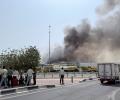
'In India, there is this first generation migrant, say from a small village in UP. He didn't go to the Gulf to buy a big house but make the life of his family better.' 'He may have paid 1 lakh rupees to an agent to go to the Gulf. Imagine what will happen to him and his family if he has to come back. He and his family will become poor again.' 'He went to the Gulf to come out of poverty, but this war will make his family trapped in poverty once again.'

Two-time Olympic medallist PV Sindhu recounts a 'tense and scary' experience at Dubai International Airport after an explosion occurred nearby, amidst escalating tensions in the Gulf region.

Prem Panicker's Must Read Blog On The Gulf War.

Russian President Vladimir Putin is actively working to de-escalate the escalating crisis in the Gulf, engaging with regional leaders following Iran's retaliatory strikes on US facilities after joint US-Israeli strikes against Iran.

'We are getting used to the constant alerts to take shelter, listening to sonic booms from jets flying above us, hearing news of neighbouring ports being targeted, and being the only ship in the terminal.'

The International Cricket Council confirmed that stranded players from the South Africa national cricket team and West Indies cricket team have finally left India after Gulf airspace closures during the West Asia conflict disrupted travel following the ICC Men's T20 World Cup.

Egypt, Pakistan, Saudi Arabia and Turkey met in Islamabad in what analysts say is the formal opening of a new diplomatic formation that could reshape the post-war regional order. Their immediate goal is a ceasefire; their larger ambition is to ensure that neither Iran nor Israel emerges from this war in a dominant position. Pakistan's foreign minister then flew directly to Beijing and mooted a Chinese role as guarantor of any eventual agreement. Prem Panicker continues his must read daily blog on the Gulf War.

'If movement remains stalled for three to four months, more than 300,000 recruitments from India could be affected.'

There are roughly 2,000 ships stranded in the Persian Gulf, carrying more than 20,000 seafarers, according to the International Maritime Organisation, as quoted by The Wall Street Journal.

Citizens and residents across the Gulf region are preparing for Eid amidst regional conflict, impacting festivities and daily life.

The cost of the war is being counted not in the corridors of power in Washington or Tehran, but in Firozabad's darkened furnace rooms, Howrah's idle casting sheds, and a barbershop in Kochi where the wait is suddenly, inexplicably, an hour long, notes Prem Panicker in his must read blog on the Iran War.

The question is no longer whether the war will expand. It has. The next few days will tell us whether the war stabilises around Hormuz or whether the Strait itself becomes the trigger for a far larger rupture. What to watch for over the next 48 hours is simple: Any move by the US toward direct naval control of the Strait; any credible Iranian attempt to disrupt or mine shipping lanes and, critically, whether energy infrastructure in the Gulf continues to be targeted.If those lines are crossed in tandem, the war will no longer be containable within the region.

Prime Minister Narendra Modi will review the impact of the West Asia conflict on India's food, energy, and fuel security with senior cabinet ministers. The meeting follows previous discussions and concerns raised about global energy crises and supply chain disruptions.

India's handling of the Iran crisis reflects a growing strain between strategic autonomy and geopolitical alignment, observes Ambassador M K Bhadrakumar.

The United States, which entered this war in expectation of a short, sharp win along the Venezuela model, is now preparing for deeper involvement in a conflict it does not fully control, without the allies it typically relies on, against an adversary that is not behaving as expected, in a global environment that is already absorbing economic shock. Prem Panicker continues his must read daily blog on the Gulf War.

The Indian government has convened an all-party meeting to discuss the ongoing crisis in West Asia, following Prime Minister Modi's address to Parliament on the situation and its potential impact on India.

Top commanders of the Indian Navy will discuss the implications of the West Asia crisis on India's energy security and review operational readiness at a three-day conference.

The Indian government reports casualties among its seafarers due to the ongoing crisis in West Asia and outlines measures to ensure the safety and welfare of its maritime personnel.

Amid escalating tensions in West Asia, the Indian government has established a control room to provide crucial support and assistance to the nearly one crore Indian citizens residing in the region.
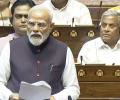
Prime Minister Narendra Modi addresses the Rajya Sabha, detailing India's strategies to navigate the global energy crisis sparked by the West Asia conflict, including securing diverse energy sources and expanding strategic oil reserves.

'The West Asia or the Gulf crisis has shown that what we develop as national infrastructure when things are not as bad as they could be, we forget to plan for adversities.'

External Affairs Minister S Jaishankar discussed the West Asia conflict and its impact on energy supplies with his Russian counterpart Sergey Lavrov and EU's Foreign Policy chief Kaja Kallas.

Kerala BJP president Rajeev Chandrasekhar criticizes the state government for the water crisis in Thiruvananthapuram ahead of the Attukal Pongala festival, alleging negligence and failure to utilize funds. He also addressed the Gulf conflict and political alliances in the state.

Elon Musk reportedly participated in a phone call between US President Donald Trump and Indian Prime Minister Narendra Modi to discuss the Iran crisis, raising questions about his involvement in diplomatic discussions.

Union Minister Pralhad Joshi assures that the Indian government is prepared to bring back Indians stranded in the Gulf region due to the Iran-Israel conflict and disruptions in Dubai, emphasizing citizen safety as the top priority.
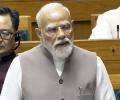
Prime Minister Narendra Modi addressed Parliament on the West Asia crisis, advocating for dialogue and diplomacy, ensuring the safety of Indians in the region, and addressing concerns about fuel and food security.

The Indian government is considering additional relief packages for vulnerable sectors like MSMEs to mitigate the impact of the ongoing West Asia crisis on the economy and inflation.

The Ministry of External Affairs (MEA) has stated that Prime Minister Narendra Modi and External Affairs Minister S Jaishankar are actively engaged with world leaders to promote dialogue and diplomacy for peace in West Asia, while also ensuring the safety and well-being of the Indian community in the region.

The limited-overs series between Afghanistan and Sri Lanka scheduled for March in the United Arab Emirates has been postponed due to the ongoing crisis in the Middle East.

Indian eateries are adapting to the LPG crisis by cutting menus, increasing prices, and switching to alternative fuels like coal, as LPG supplies are disrupted due to global events. State authorities are cracking down on hoarding and black marketing of LPG cylinders.

India's foreign secretary Vikram Misri on Thursday participated in a high-level meeting hosted by the United Kingdom on the evolving situation in West Asia, underlining concerns over maritime security, energy supply disruptions and the need for diplomatic de-escalation.

When missiles fly in this region, they are never just aimed at military targets.

'We are profoundly energy-dependent on the Gulf. That dependency must now be redirected towards the United States, because we require American permission to procure oil.' 'We additionally require Iranian permission to acquire oil from that source. So India now has to seek two separate permissions merely to secure its energy supply.' 'Should we be compelled to source from America, or from Venezuela -- which is, in effect, American-controlled supply -- that will inevitably carry a price premium, an elevated shipping cost, and a considerably extended delivery timeline, given the distances involved.'

US President Donald Trump and Russian President Vladimir Putin discussed the Iran conflict and its impact on global energy supplies during a phone call.

Iran has blamed the US for disruptions in oil and gas shipping through the Strait of Hormuz, citing 'destabilising actions' as the cause amid the ongoing West Asia conflict and rising energy prices.

Indian rice exporters are seeking urgent government support to mitigate the impact of shipping disruptions caused by the Iran crisis and instability in key maritime routes. The disruptions have led to increased freight rates, insurance premiums, and fuel costs, impacting domestic prices and exporter profitability.
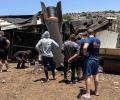
India addresses the escalating conflict in West Asia, outlining its diplomatic efforts to ensure energy security, the safety of its citizens, and advocating for a peaceful resolution through dialogue.

Will rising tensions between US-Israel and Iran threaten crude oil supply through the Strait of Hormuz, putting India's fuel prices, imports, and economic stability at risk?
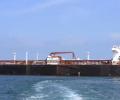
Despite ongoing tensions in West Asia, the successful arrival of the LPG carrier 'Nanda Devi' in Gujarat ensures a steady supply of liquefied petroleum gas to India, highlighting the country's efforts to secure its energy needs.
 © 2026 Rediff.com - Advertise with us - Disclaimer - Privacy Policy - Sitemap - Feedback - About us - Terms of use - Grievances